Introduction
In modern industry, automation is the key to consistency, efficiency, and safety. At the centre of it all is the Programmable Logic Controller (PLC) – the hardware and software that gives machines the ability to make decisions and respond in real time.
But while PLCs themselves are powerful, the programming behind them is what determines whether a system performs efficiently or struggles with downtime and faults. Professional PLC programming ensures machines operate safely, smoothly, and reliably, with logic that’s built for both present needs and future growth.
1. Understanding PLC Programming
A Programmable Logic Controller is a rugged industrial computer designed to control machinery and processes.
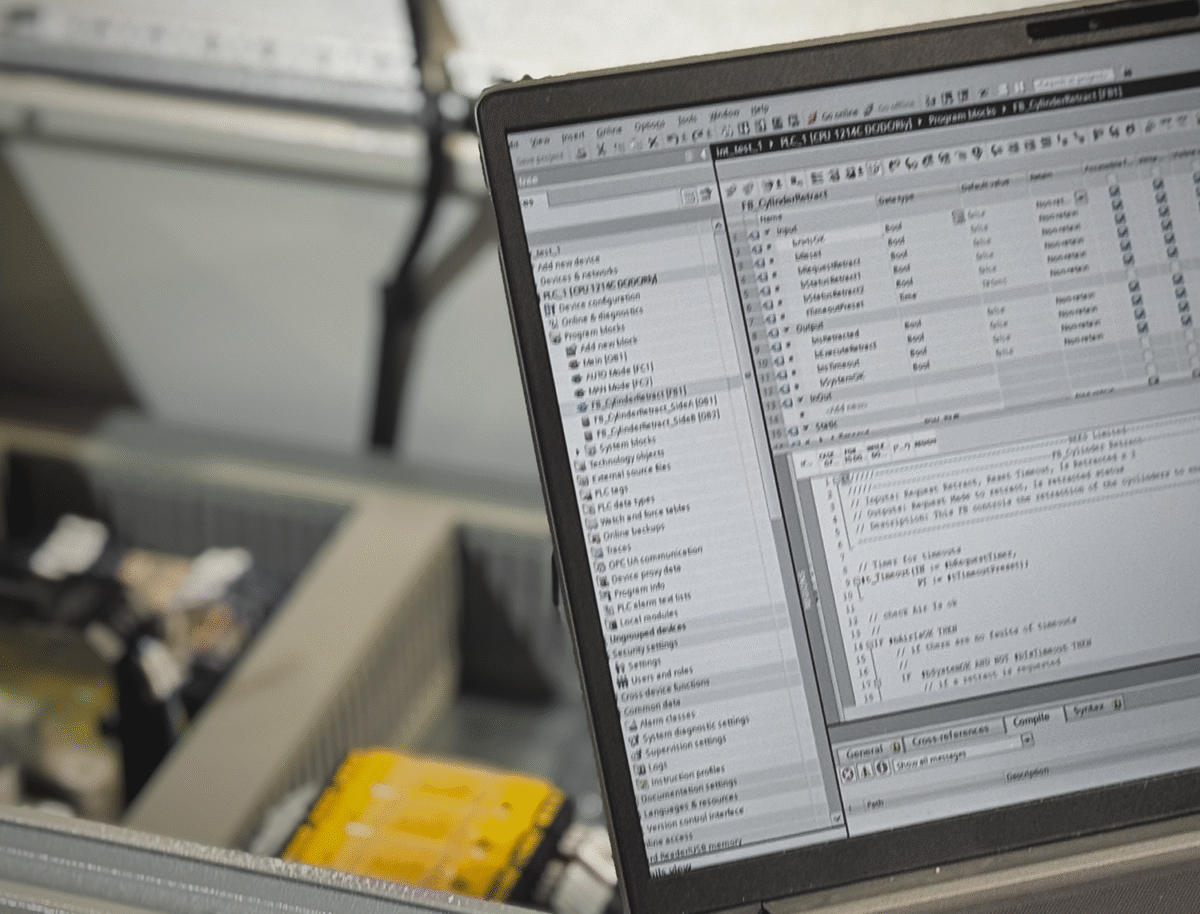
PLC programming involves writing the digital logic (often in ladder, function block, or structured text) that governs when and how different parts of a machine operate – pumps, valves, conveyors, motors, sensors, and alarms.
The program defines every sequence, interlock, and condition, ensuring that equipment responds correctly to inputs and performs as intended.
2. Why Professional Programming Matters
Reliability and Uptime
Professionally developed PLC code follows structured logic, standardised conventions, and extensive testing. This minimises programming errors and unpredictable machine behaviour.
A well-tested PLC program ensures equipment operates consistently across shifts, reducing unplanned downtime and maintenance callouts.
Optimised Performance and Efficiency
Skilled programmers understand both software and process control. They can fine-tune timing sequences, eliminate unnecessary waits, and balance system loads to maximise throughput – all while protecting motors, actuators, and sensors from unnecessary wear.
Safety and Compliance
Industrial and scientific systems must meet strict safety and operational standards (BS EN, IEC, and HSE regulations).
Professional programming ensures correct operation of emergency stops, safety interlocks, alarms, and fail-safe conditions. This is especially critical in industries such as medical device manufacturing, pharmaceutical processing, and laboratory automation, where equipment reliability and compliance are non-negotiable.
Ease of Maintenance and Troubleshooting
Professionally written programs are clearly structured and documented, with intuitive tag naming and logical segmentation. This allows engineers to diagnose and resolve issues quickly, minimising downtime and cost.
Good programming also integrates diagnostics and status reporting – giving maintenance teams valuable insights through HMIs or SCADA systems.
Flexibility and Future-Proofing
Industrial systems rarely stay the same forever. Professional programmers design code with modularity in mind, so updates, new sensors, or process expansions can be integrated easily.
Future-proof programming saves time and cost when systems evolve, avoiding full reprogramming or panel rebuilds.
3. The Hidden Cost of Poor Programming
Poorly structured PLC code can have serious implications:
- Inconsistent operation or product quality
- Conflicting logic leading to faults or system crashes
- Unsafe operation or failed compliance audits
- Increased downtime and maintenance costs
Even if a system appears functional, inefficient or untested logic can lead to energy waste, reduced throughput, or long-term reliability issues.
4. Real-World Impact Across Industries
Manufacturing and Production
Well-written PLC logic ensures machinery starts, runs, and stops in perfect sequence – coordinating conveyors, robots, and sensors for maximum efficiency.
Process Control
In process industries, accurate timing and temperature control are vital. A robust PLC program maintains setpoints precisely, ensuring consistent quality and reducing waste.
Medical and Scientific Equipment
In critical applications like washers, disinfectors, and sterilisation systems, PLCs manage heating, dosing, cycle timing, and safety monitoring.
Professional programming guarantees repeatable performance, meeting hygiene and regulatory standards every cycle.
What Makes a Good PLC Program?
A high-quality PLC program should:
- Be logically structured and modular
- Include detailed comments and documentation
- Use clear, descriptive variable names
- Integrate safety and alarm logic correctly
- Allow for future expansion and upgrades
- Undergo thorough simulation and on-site testing before commissioning
These practices ensure systems perform reliably and are easy to maintain or modify over their lifetime.
Conclusion
Professional PLC programming is an investment in efficiency, reliability, and safety.
Well-structured, tested, and documented logic reduces downtime, improves performance, and ensures compliance across industries – from heavy manufacturing to precision medical equipment.
While PLCs may be the brains of automation, it’s the quality of the programming that determines how effectively those brains work.
In industrial automation, good programming doesn’t just control machines – it drives progress.
How BEES Ltd Can Help
At BEES Ltd, our Control and Automation team designs, programs, and builds bespoke PLC and control panel systems tailored to each application.
We apply industry best practices, compliance standards, and years of automation experience to deliver systems that perform reliably from day one – and continue to do so for years to come.
If you’re looking to improve system performance, upgrade existing control logic, or design new automation from the ground up, BEES can help turn your process into a smarter, safer, and more efficient operation.